ALD22 Books: The Matter of Everything, Dr Suzie Sheehy

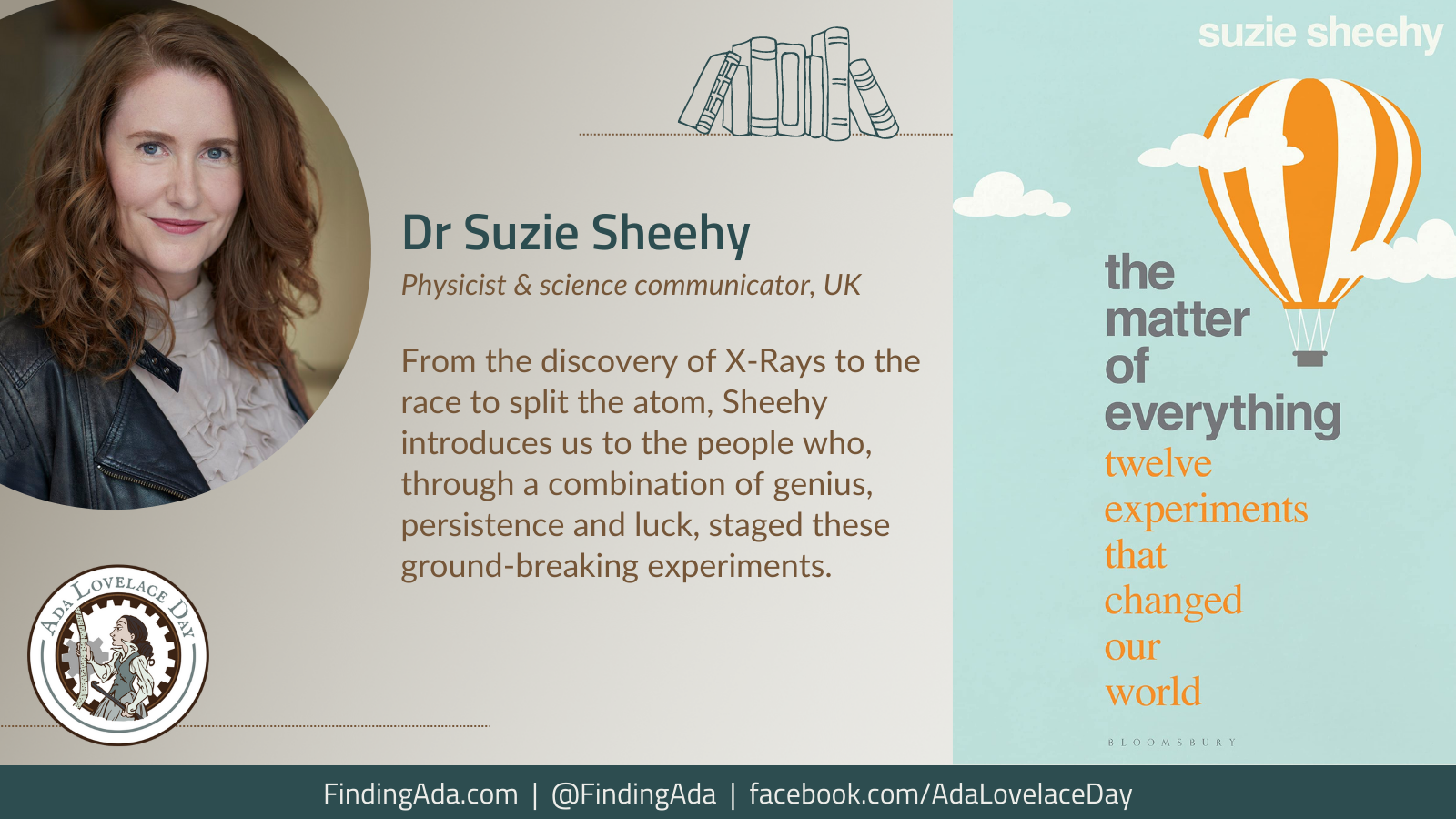
The Matter of Everything: Twelve Experiments that Changed Our World, Dr Suzie Sheehy

Asking questions has always been at the heart of physics, our unending quest to understand the Universe and how everything in it behaves. How do we know all that we know about the world today? It’s not simply because we have the maths – it’s because we have done the experiments.

In The Matter of Everything, accelerator physicist Suzie Sheehy introduces us to the people who, through a combination of genius, persistence and luck, staged the ground-breaking experiments of the twentieth century that changed the course of history. From the serendipitous discovery of X-rays in a German laboratory, to the scientists trying to prove Einstein wrong (and inadvertently proving him right), to the race to split open the atom, Sheehy shows how our most brilliant, practical physicists have shaped innumerable aspects of how we live today. Radio, TV, the chips in our smartphones, MRI scanners, radar equipment and microwaves, to name a few: these were all made possible by their determination to understand, and control, the microscopic.

Pulling physics down from the theoretical and putting it in the hands of the people, The Matter of Everything is a fascinating expedition through the surprising, and occasionally accidental, experiments that transformed our world, and a celebration of the creative and curious people behind them.

Order the book on Bookshop.org.uk here and your purchase will support a local independent bookshop of your choice!

About the Author

Dr Suzie Sheehy is a physicist, science communicator and academic who divides her time between her research groups at the University of Oxford and University of Melbourne. Her research addresses both curiosity-driven and applied areas and is currently focused on developing new particle accelerators for applications in medicine. She was awarded a Royal Commission for the Exhibition of 1851 fellowship and was a Royal Society University Research Fellow at the University of Oxford.

An award-winning public speaker, presenter and science communicator, Suzie is dedicated to sharing science beyond the academic community. Her 2018 TED talk has been viewed over 1.8M times and she has been an expert TV presenter for a number of Discovery Channel shows including four seasons of Impossible Engineering. In her talks and shows, Sheehy loves to bring real-life demonstrations and experiments, and has shared these with hundreds of thousands of audience members. She also designed Accelerate! a particle physics showed aimed at children, which ran in the UK and Germany.

You can follow her work here:

Twitter: @suziesheehy
Instagram: @drsuziesheehy
Website: suziesheehy.com
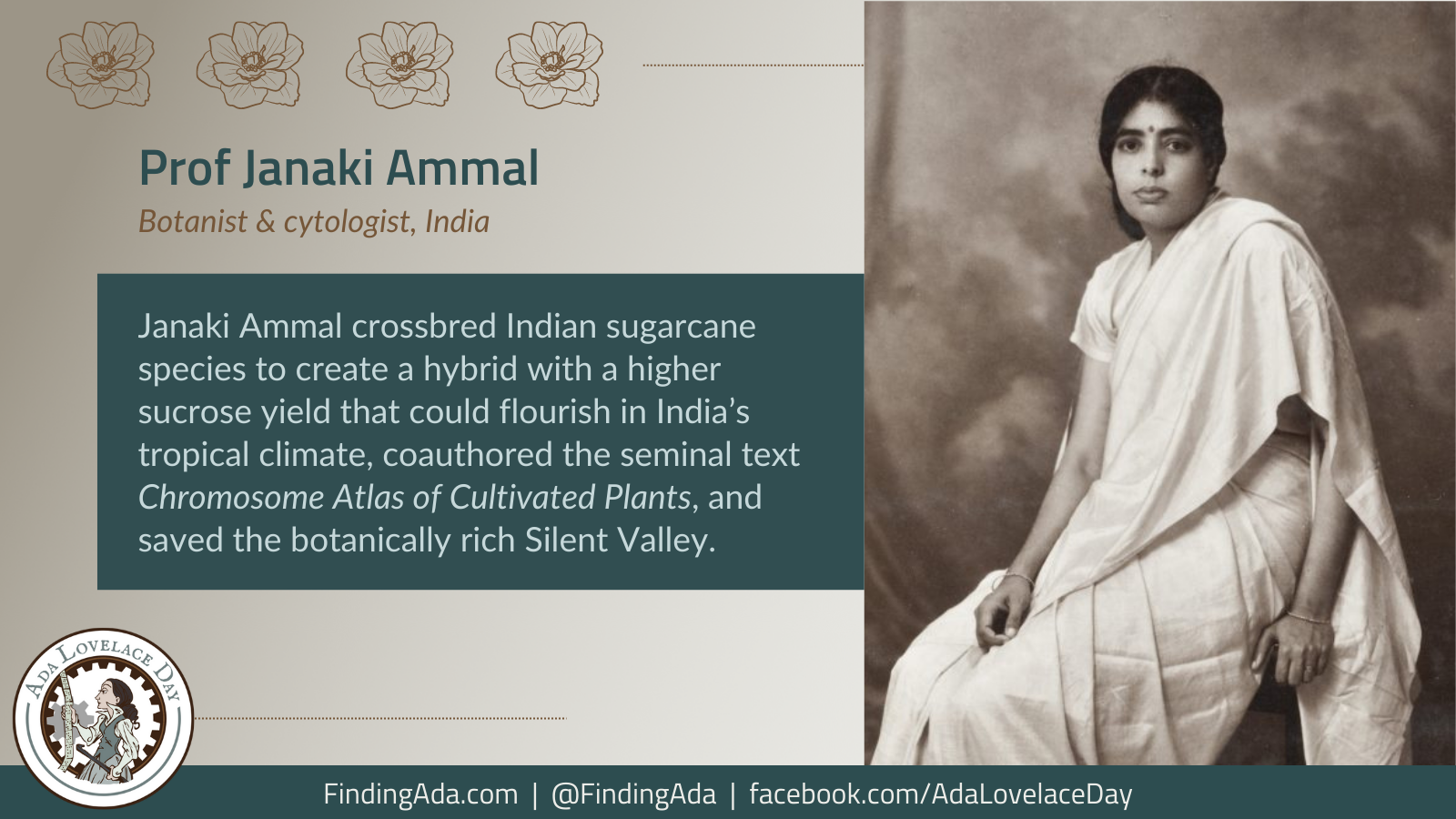
ALD22: Professor Janaki Ammal, Botanist and Cytologist

Janaki Ammal

Prof Janaki Ammal

Prof Janaki Ammal was born in 1897 in Kerala, India. She completed her undergraduate study at Queen Mary’s College, Chennai, and an honours degree from Presidency College before going to the USA to earn her master’s degree in botany in 1926, and a few years later her doctorate, from the University of Michigan.

After spending two years as a professor at the Maharaja’s College of Science in Trivandrum, she joined the Sugarcane Breeding Institute in Coimbatore. Her research focused on improving native Indian sugarcane species, which was not as sweet as the Saccharum officinarum plants the country was importing from Java. By cross-breeding dozens of plants to create hybrids in her laboratory, she developed a strain that yielded more sucrose and would grow well in tropical Indian conditions.

Unfortunately, as a single woman from a caste considered low, Ammal faced prejudice from her male colleagues, and she returned to the UK in 1940. She worked with Cyril Dean Darlington at the John Innes Institute and, over the course of five years, they wrote the Chromosome Atlas of Cultivated Plants, which records the chromosome number of around 100,000 plants and which is still a core text for modern plant scientists.

In 1946, Ammal joined the Royal Horticultural Society in Wisley as a cytologist, studying the structure and function of cells, and their first salaried female staff member. There, she studied the chromosomes of a wide number of garden plant species to better understand their evolution and varieties. She was particularly interested in magnolia, and several of her shrubs still survive at Wisley today.

She treated some magnolia seeds with a solution of colchicine, a drug usually used to treat gout, which resulted in the seedlings doubling the number of their chromosomes. The seedlings grew faster, showed variations in their leaf texture and developed longer-lasting flowers. One of her varieties, which has white petals and purple stamens, is named Magnolia kobus ‘Janaki Ammal’.

After World War II, she returned to India to become the first director of the Central Botanical Laboratory at Allahabad and manage the Botanical Survey of India, which had been established in 1890 to collect and catalogue India’s flora.

India had suffered some widespread famines in the 1940 during which millions died, and the Indian government was deforesting vast swathes of land, much to Ammal’s distress. She became much more active in working to protect India’s flora, in particular trying to ensure that Indian scientists had access to specimens collected from their own country. She was also instrumental in stopping a hydroelectric dam that would have flooded the botanically diverse Silent Valley. She headed a chromosomal survey of the Valley’s plants, and eventually the government shelved the project.

The Indian government awarded her the Padma Shri, the country’s fourth-highest civilian award, in 1977. In 1999, two awards were named after her: The EK Janaki Ammal National Award on Plant Taxonomy and EK Janaki Ammal National Award on Animal Taxonomy. And in 2019, a rose was named after her.

Further Reading

ALD22: Professor Fumiko Yonezawa, Theoretical Physicist

Fumiko Yonezawa

Professor Fumiko Yonezawa

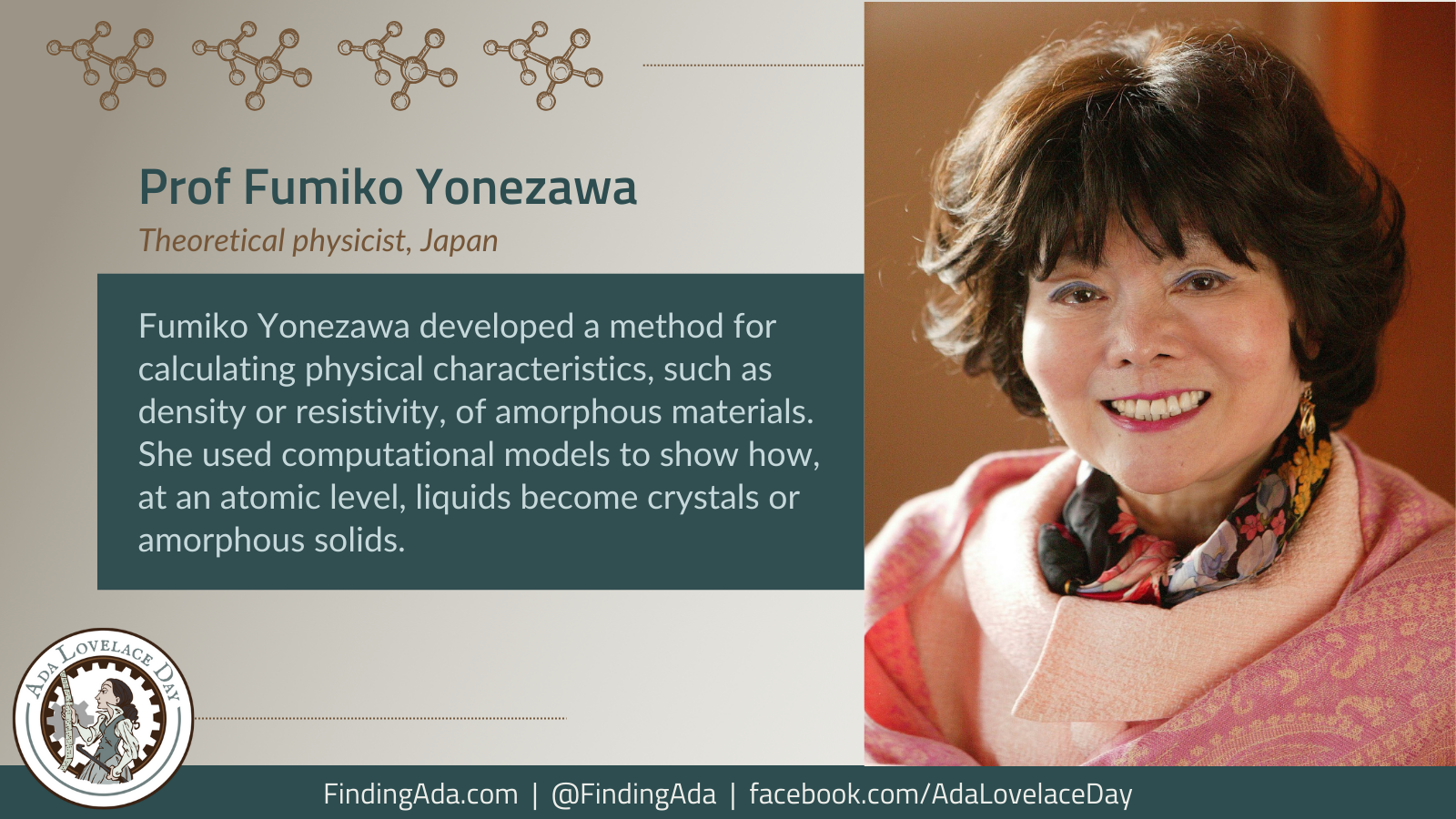
Born in 1938, Fumiko Yonezawa, 米沢 富美子, was a theoretical physicist who studied amorphous materials, semiconductors and liquid metals.

Her career began when she studied amorphous materials, or glasses, as part of her doctorate at Kyoto University in the mid-1960s. She developed the Coherent Potential Approximation (CPA), a method for calculating physical characteristics, such as density or resistivity, of amorphous materials.

Later, at Keio University, Yonezawa and her team studied how, at an atomic level, liquids become crystals or amorphous solids, using computational models. She spent some time at City College of New York, returning to Japan in 1981. In the 1990s, she developed a “theory of metal-insulator transition in liquid selenium” and became interested in neural networks.

In 1984, she was awarded the Saruhashi Prize, which is awarded to Japanese women for research in the natural sciences, for her “Theory of Fundamental Physical Properties of Amorphous Materials”. She was the first woman to become President of the Physics Society of Japan in 1996 and, in 2005, she won a L’Oréal-UNESCO Award for Women in Science for “pioneering theory and computer simulations on amorphous semiconductors and liquid metals.”

In 2020, the Physical Society of Japan launched the Fumiko Yonezawa Memorial Award to “honor and encourage” female members of the society, presenting awards to five women in physics in Japan.

Fumiko Yonezawa died on 17 January 2019, aged 80.

Further Reading

ALD22: Professor V Narry Kim, Biochemist and Microbiologist

V Narry Kim

Professor V Narry Kim

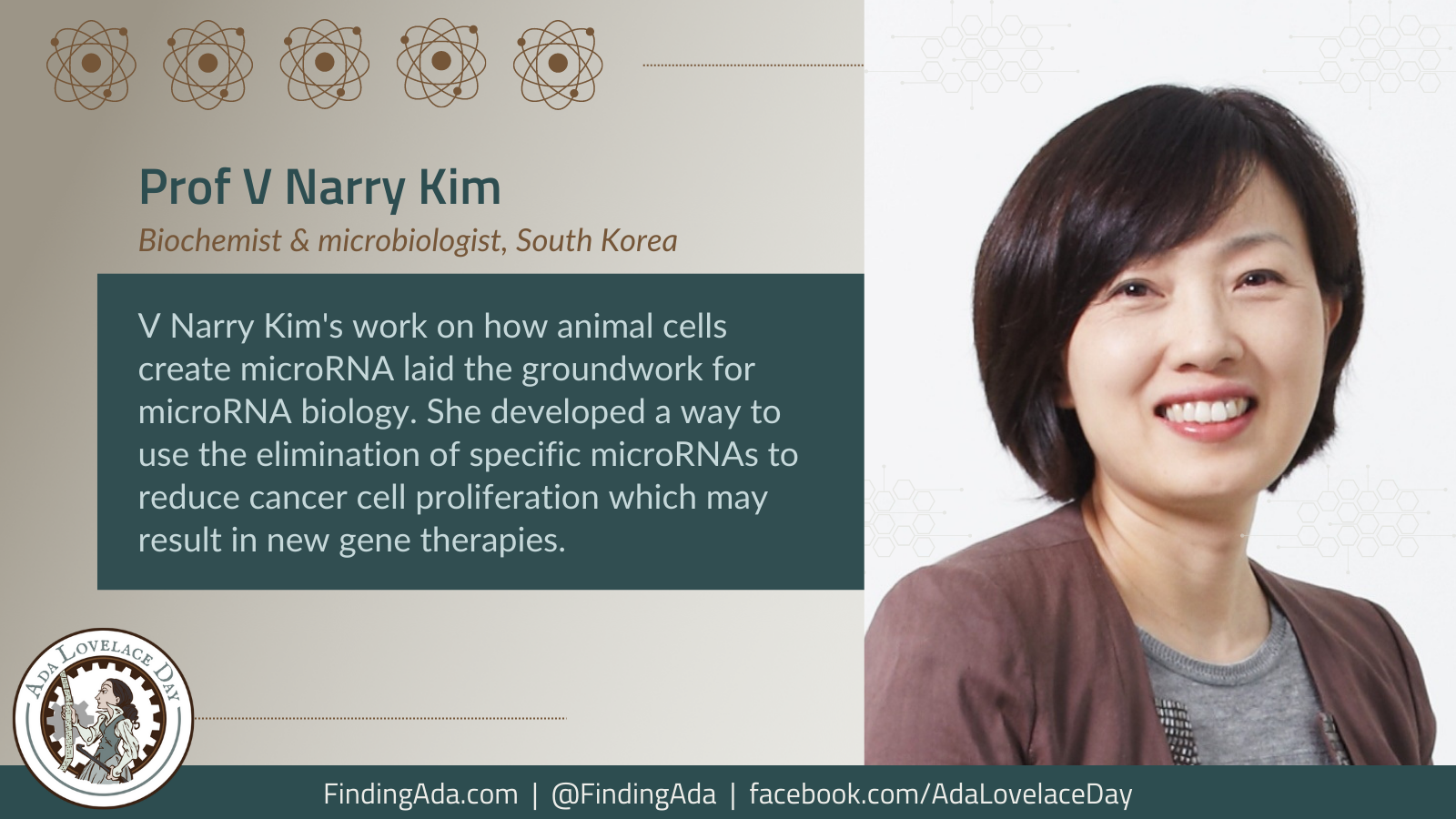
V Narry Kim, born in South Korea in 1969, is a biochemist and microbiologist at Seoul National University (SNU) working primarily with microRNA biogenesis.

She first became interested in science as a high school student and, in an interview, said she chose it as a lifelong career because of her fascination with “the simplicity of the principles underlying the complexity of life”. She completed an undergraduate degree in microbiology and a master’s degree in microbiology at SNU. She then graduated from the University of Oxford with a PhD in biochemistry on retroviral proteins.

After her PhD, Kim took a research assistant position at the Howard Hughes Medical Institute at the University of Pennsylvania studying messenger RNA surveillance, the mechanism by which cells double-check the quality of their messenger RNA molecules. On completing her postdoctoral research, she returned to SNU in 2001 where she started working as a research assistant professor, eventually becoming a distinguished professor.

Kim founded the Centre for RNA Research at the Institute for Basic Science (IBS), where her research focuses on RNA-mediated gene regulation. Her lab has made significant contributions to the understanding of how microRNAs – small single-stranded non-coding RNA molecules that play a key part in regulating gene expression – are created and processed in animal cells. She and her colleagues developed a new technology to eliminate specific microRNAs which when applied to cancer cells led to a drop in their proliferation rate. This may result in new gene therapies.

Kim has received several awards including the L’Oreal-UNESCO Award for Women in Science, Ho-Am Prize in Medicine, Korean S&T Award, and was named Woman Scientist of the Year by South Korea’s Ministry of Science and Technology. She also has several patents for her work, such as an HIV-based gene delivery vector. She was elected a foreign member of the Royal Society in 2021.

Further Reading

ALD22 Podcasts: Ologies, Alie Ward

Ologies, Alie Ward

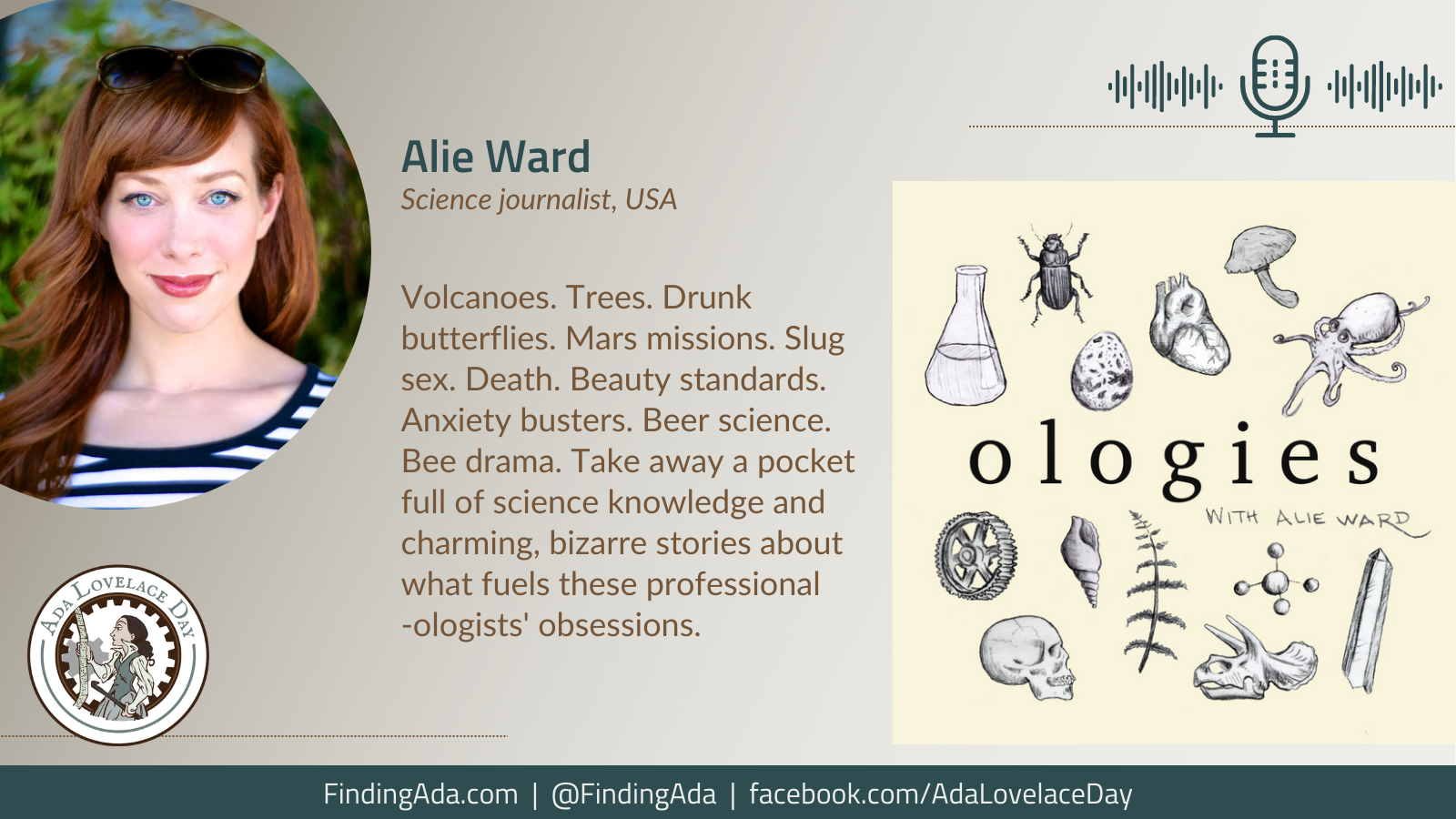
Volcanoes. Trees. Drunk butterflies. Mars missions. Slug sex. Death. Beauty standards. Anxiety busters. Beer science. Bee drama. Take away a pocket full of science knowledge and charming, bizarre stories about what fuels these professional -ologists’ obsessions. Humorist and science correspondent Alie Ward asks smart people stupid questions and the answers might change your life.

Recent episodes: 

  • Mountain goats are not goats. And there’s only one living species, Oreamnos americanus. WHAT?? Montana-based wildlife biologist and Oreamnologist Julie Cunningham talks about her work studying these animals. 
  • How many legs? Why so many legs? What’s a millipede versus a centipede? And again WHY SO MANY LEGS. Ologies has just the guy for that: Diplopodologist Dr. Derek Hennen.
  • How do societal structures affect the planet? Why should we get to know our neighbours? What’s the ecological price we pay for … stuff? Ologies chats with the founder of Critical Ecology: biogeochemist, National Geographic Explorer, researcher and plant nerd, Dr. Suzanne Pierre.
  • If you have a physical body, or know someone who does, this episode is for you! Hello, we’re all going to die. And we’re probably all going to lose someone we love. Ologies talks to thanatologist Cole Imperi. 
  • Cheloniologist Dr Camryn Allen met up with Alie on a tropical island (ok, in a hotel room on a tropical island) to chat about flipper slappings, turtle rodeos, nesting BBs, current surfing, endangered statuses, field work, sleeping under water, and more. 

You can:

Listen on Apple
Follow on Twitter: @Ologies @AlieWard