
Last year’s 2025 Lovelace Report (no relation) from OliverWyman and WeAreTechWomen is well worth your time if you haven’t read it already. It comes out of the gate hard, pointing out that the tech industry alone “loses between £2 billion and £3.5 billion annually through a broken career framework that ’s driving out talent across the board, with women bearing the heaviest cost.”
The report does not look at science, engineering, or maths-related industries, but it’s hard to imagine that their figures are any better.
That enormous loss is down to the 40,000 to 60,000 women who leave their tech or digital role every year, with 20,000 to 30,000 of those leaving the industry completely. The rest move to a job elsewhere in tech.
An estimated £1.4 billion to £2.2 billion is lost every year from women leaving the industry, plus another £640 million to £1.3 billion squandered from the churn of women switching employers for a new tech role, resulting in productivity losses, costly onboarding, endless recruitment cycles, and limiting the potential of the industry.
And a lot more women are thinking of leaving. In fact, of the women in tech that were surveyed, nearly 80 percent had “recently left or are interested in leaving their tech roles”. The problem is especially acute in mid-career, with women “most likely to leave the tech industry altogether after six to 15 years”.
Why do so many women leave tech? Contrary to popular opinion, it’s not down to caring responsibilities, which is “the primary driver for just 3% of cases”. No, instead, the top three reasons women leave a job are:
- Limited direction and opportunity in career progression
- Lack of recognition
- Inadequate pay
Other factors include “dissatisfaction with company culture and working conditions” and “the absence of role models or a supportive network, manifesting as lack of sponsorship that hampers advancement.”
Furthermore, women have to wait longer for promotion, ie three to four years, compared to an industry average of around two years. And in mid-career, between 10 and 20 years in, over 75 percent of women say they have been waiting more than three years to get a promotion. Almost 40 percent of women with more than 20 years experience are waiting more than five years.
This mid-career crisis is a serious problem for businesses as it means fewer women to promote into senior leadership roles. This in turn makes reaching gender parity in senior roles harder to achieve, something companies should very much want to tackle as a matter of urgency because companies with more women in senior roles have been shown to be more profitable.
And just to rub salt into the wound, women are also paid less than industry benchmarks for their level of seniority. Some 60 percent of mid-career women earn less than the £100,000 benchmark, and 80 percent of women with 20 years or more of experience are earning less than the £200,000 benchmark.
Barriers to progression
Despite the fact that nearly 70 percent of women are gaining additional qualifications and doing more training, they are not seeing that self-directed professional development work “translating into career progression”. Women are improving their tech skills, their leadership skills and other key soft skills, but aren’t being rewarded for their effort.
Most women, some 90 percent, would like to move into management with three quarters actively pursuing such a move. Only a quarter think this will happen easily for them. Barriers include:
- Lack of clear opportunities
- No established path to senior roles
- Unequal distribution of high-visibility work
- Lack of sponsorship
- Persistent promotion bias in a male-dominated culture
And these issues worsen as women age:
Mid-career and senior-level women are hit hardest, stalling out because the path ahead disappears. Growth opportunities dry up, the route to senior roles is murky, and mentorship programmes that actively track and measure against outcomes that will accelerate women’s careers are missing. For senior-level women (those with 11 to 20 years of experience), the slowdown is even sharper.
Across all levels, the support systems women need simply aren’t in place. Forty percent don’t have a written development plan. One in four still runs into culture and promotion bias. One woman put it plainly: “At the moment, it feels like a matter of luck — or other than that, entirely hopeless.” These aren’t exceptions; they’re symptoms of a system that ’s long overdue for a redesign.
Women can’t even move laterally within their existing company, despite 40 percent being open to such a move. The top three barriers are:
- Lack of a clear pathway for transition
- Suspicion that pay would be lowered in the new role
- Lack of a strong network or cross-industry connections
The solution lies with management
Women are not the problem here. They are putting in the hard yards, but they are not being rewarded for it.
If things are to change, business — ie senior management — needs to step up to the plate. The 2025 Lovelace Reportmakes some very clear, concrete ideas on how companies can stem the flow, based “on what women say they need most”:
- Develop and genuinely sponsor mid-level women
- Spot women before they walk
- Make sure high-impact work is given fairly
- Back women with sponsors who open doors
- Run sponsor-sponsee survey to understand how “matching” is working in practice
- Grow and promote authentic visibility for senior-level women
- Give senior-level women real leadership opportunities
- Put visibility and value on the agenda
- Help them plan what’s next
- Make career pathways crystal clear at every level
- Build career maps that actually work
- Make pay match the path
- Use maps to drive real development
- Open up internal opportunities
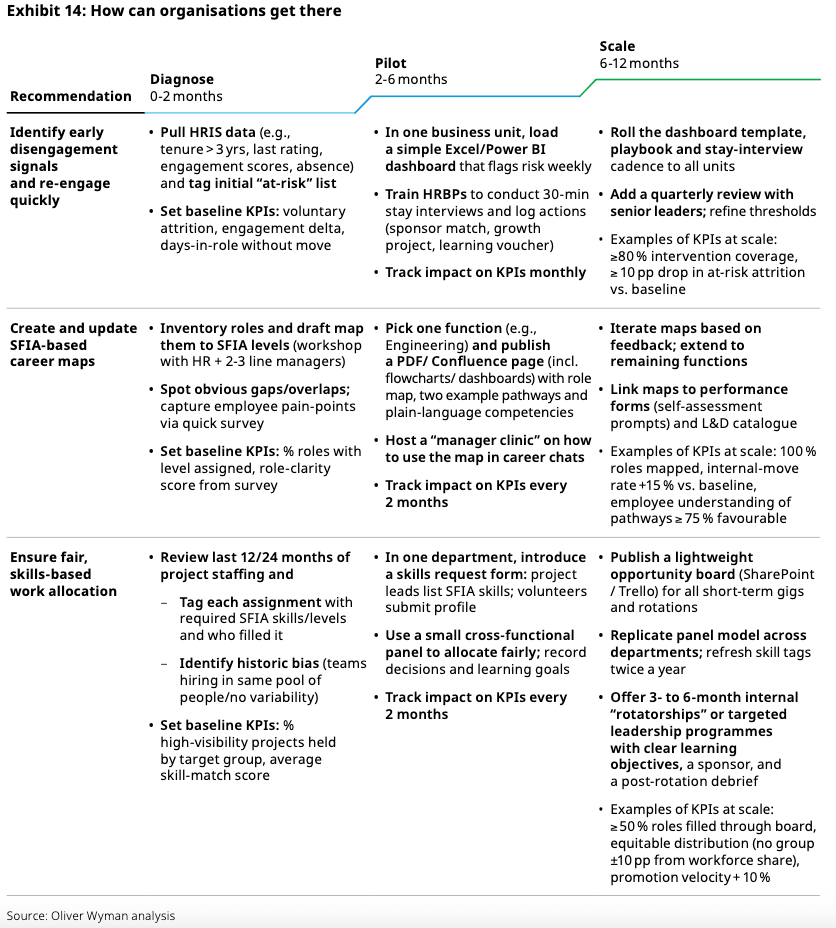
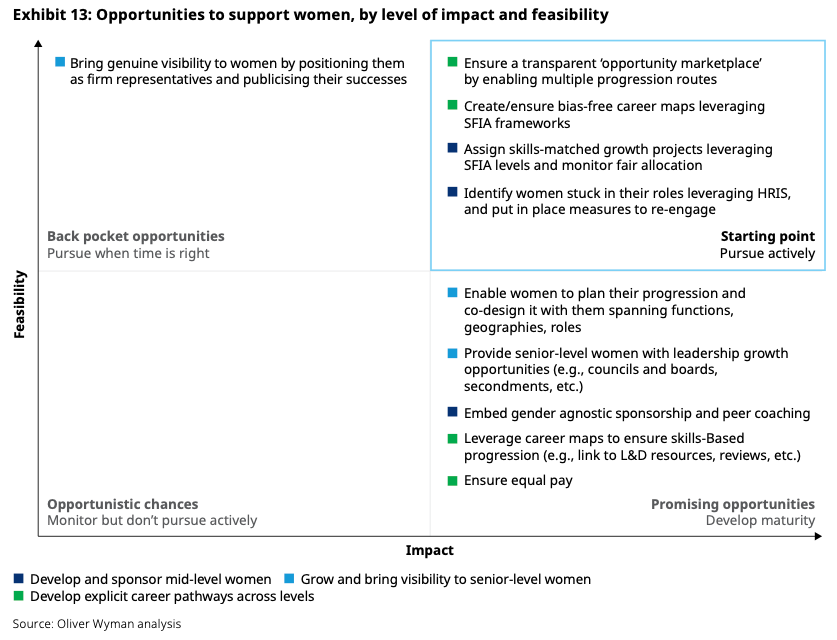
Unlike a lot of reports that make high-level recommendations and then move on, the 2025 Lovelace Report goes into significant detail about what these recommendations mean and how they can be executed. The authors recognise that companies can’t do everything at once and highlight three priorities:
- Identify women who’ve been stuck in the same role for years and “re-engage them through skills-matched projects, coaching, development programmes, and sponsorship”
- Ensure that “high-impact work is assigned fairly by matching opportunities to skills and tracking who gets access”
- Create clear career maps and pathways so that everyone knows how to progress
These interventions are, the authors say, “highly feasible and proven to make a difference”.
Is your company acting?
Is your employer acting on these (or similar) recommendations? And if they aren’t, do you have a sense of why not?
Women’s networks, ERGs and mentoring programs seem fairly common, but what about the other recommendations? Does your company have a career map or provide clear pathways to progress? Are opportunities to work on keystone projects fairly distributed, with ways to check that this is so?
Please leave a comment with your experience!
Sponsors
This work is sponsored by Digital Science. If you’d also like to become a sponsor, to get early access to the report and a briefing on how its findings affect your company, email me for details.