ALD Report: How well do interventions designed to increase gender equity work?

Go on. Take a guess.

I spent last week reading four systematic reviews of the scientific literature on interventions designed to increase gender equity to try to get a sense of what is being done and whether it works or not. It would be a kindness to describe results as ‘mixed’.

Tl;dr

Because this is an unusually long post, I’ll give you the main findings now:

  • There isn’t much research on gender equity interventions
  • What research has been done is usually of poor quality
  • Most of the positive conclusions aren’t supported by the data
  • Most studies focus on changing women, rather than organisations or systems
  • Doing this kind of research in the real world is hard
  • The jargon’s a nightmare because everyone uses different frameworks and language
  • A key missing piece of the jigsaw is how we overcome male hostility to gender equity interventions

As frustrating as that overview is, these reviews do give us some insight into the kinds of gender equity interventions that have been tried and how to analyse and evaluate them, which then gives us a sense of where to go next.

A “paucity of literature”

The first thing to note is that not a lot of research has been done to evaluate the success of gender equity interventions, with fewer than 80 relevant papers found even by the most broadly defined search.

Tricco et al (2024) looked for randomised controlled trials (RTCs) “on interventions examining gender equity in workplace or volunteer settings” that targeted individuals, organisations or systems. After screening 8,855 citations, they found only 24 unique RTCs that fit their criteria.

“There is a paucity of literature on interventions to promote workplace gender equity,” they said in their abstract.

Guthridge et al, (2022) had a much wider remit, looking for any “social justice, cognitive, or behaviour-change interventions that sought to reduce gender inequality, gender bias, or discrimination against women or girls” that were “implemented in any context, with any mode of delivery and duration, if they measured gender equity or discrimination outcomes, and were published in English in peer-reviewed journals”. They sifted 7,832 citations and found 78 papers.

Lydon et al (2022) looked for “Peer-reviewed studies published between 2000 and March 2020 that evaluated interventions to improve gender equity, or the experiences of women, in academic or clinical medicine”, finding 34 relevant studies.

And finally, Lau et al (2022) also focused on studies from 2000 to 2020 that had been published in the “management, psychology, and feminist literature”. They screened 2,166 articles and found 77 that were relevant, noting that “this means that less than 5% of the gender and diversity research across three disciplines” addressed gender equity interventions.

I haven’t compared the lists of papers to see how much overlap there is, but if anyone fancies doing that, please share your results!

Quality problems

Not only is there a poverty of research, much of the research that has been done is not high quality.

Guthridge et al pointed out that “Overall research quality was low to moderate, and the key findings created doubt that interventions to date have achieved meaningful change.”

Lydon et al graded the papers they reviewed from 1, no clear conclusions, to 5, unequivocal. They found that the vast majority of papers (64.7%) scored 1 or 2, “indicating that the conclusions presented were not supported by the data collected”, with not one paper scoring 5.

Lau et al discuss why this research is challenging, explaining that lab-based studies might be “theoretically interesting and empirically rigorous”, but they “offer fewer practical implications or relatively little guidance on how the interventions might be successfully applied in the workplace”.

Furthermore, they focus on “brief interventions” that can easily be tested in a lab, but don’t think about the “long-term sustainability of those changes”, ignoring the complexity of most workplaces.

Meanwhile, whilst “management scholars tend to use archival and field data” which are more representative of the real world, their studies provide limited insights into the “mechanisms, boundary conditions, and unintended side-effects of interventions”.

But did these interventions work?

Tricco et al found that most of the studies (87.5%) drew positive conclusions, “meaning that there was an effect of the intervention” but warn that “this does not imply that the gender equity interventions work”.

Guthridge at al were a bit more specific:

Improved gender inclusion was the most frequently reported change (n = 39), particularly for education and media interventions. Fifty percent of interventions measuring social change in gender equality did not achieve beneficial effects. Most gender mainstreaming interventions had only partial beneficial effects on outcomes, calling into question their efficacy in practice. Twenty-eight interventions used education and awareness-raising strategies, which also predominantly had only partial beneficial effects.

Whilst Lydon et all said that, “Outcomes were largely positive (87.3%)”, they then pour cold water on those findings by saying that “measurement typically relied on subjective, self- report data (69.1%)” and that “weak methodological rigour and a low strength of findings was observed”, implying that the claimed outcomes are perhaps not to be trusted.

Furthermore, they point out the very large elephant in the room, that “many of the programmes considered to be more successful in this area are well funded and supported. Similar effects are unlikely in settings that lack these resources.”

When interventions fail because they are underfunded and underresourced, they can be used by sceptics as evidence that such interventions can never work, and that we therefore shouldn’t try.

Intervention frameworks

One of the most useful parts of these papers has been seeing how some of the authors categorise gender equity interventions.

Tricco et al, whose study inclusion criteria were extremely broad, used six categories:

  • Quantifying gender impacts, eg publishing gender data
  • Behavioural or systemic changes, eg recognising the need for gender equity, using gender-neutral language during recruitment, quotes, and training on gender bias
  • Career flexibility interventions, eg flexible scheduling or addressing “work-family conflict”
  • Increased visibility, recognition and representation interventions, eg promoting manuscript writing in academia, business training, leadership programs, or role models
  • Creating opportunities for development, mentorship and sponsorship interventions, eg peer mentoring
  • Financial support interventions, eg microfinance

But I also like the categories put together by Lydon et al:

  • Equip the woman, eg professional development, leadership training, speaker training, mentorship,
  • Create equal opportunities, eg pay transparency, financial awards, targeted recruitment of women for senior positions
  • Value relational skills and increase visibility, eg networking, monthly lunches
  • Assess and revise the work culture, eg structured dialogues, diversity councils, ombudsmen, implicit bias training

The majority of studies (82.4%) in Lydon et al’s review fell into the Equip The Woman category, with half of them onlyexamining this kind of intervention. They say:

focusing training on women only implies that women are responsible for their stalled career progress, when in fact, it is the inequitable system that pushes women to learn additional skills, navigate labyrinths, and seek to overcome double binds to succeed.

Framing women as the problem implies that changing women is the solution. I’ve said before that women are hampered by the way we are socialised as children – to not take up too much space, keep our heads down, take on more pastoral care, try hard to be likeable and to sacrifice our own needs in order to support others. We are also punished for exhibiting masculine-coded behaviours such as having clear opinions, drawing boundaries and having ambitions.

Putting the onus on women to change these often deeply internalised behaviours, many of which we might not realise we are doing but all of which are enforced by society, is both the easy option and the least likely to succeed.

These interventions are easy – professional development programs are widespread and simple to set up and administer. They can be very valuable for participants in general, so I’m definitely not knocking them. But they are less likely to succeed because it doesn’t matter how well trained a woman is if she is stuck in a misogynist system.

Intervention levels

Reviewers also looked at how interventions were targeted. Tricco et al had the simplest set of categories:

  • Individuals, eg diversity training, unconscious bias, mentoring, coaching
  • Organisations, eg policy, codes of conduct, action plans
  • Systems, eg legislation

Guthridge et al also outlined a three-part system for the contextual levels which they then used to categorise interventions:

  • Microlevel: “individual characteristics, including biology, beliefs, behaviours, values, and emotions, such as empathy and resentment”
  • Mesolevel: “interpersonal interactions in family, work, and school etc. (e.g. gender segregation)”
  • Macrolevel: “broader social and cultural norms, including religion and politics”

They emphasise that these levels all affect one another, that strategies which work across levels are more likely to succeed. That said, interventions which work at the microlevel may not work at the macrolevel. It is, in short, complicated.

Lau et al created a five level system:

  • Ontogenic microsystem: behaviours, dispositions, identities
  • Interpersonal microsystem: mentors, supervisors
  • Organisational microsystem: practices, technology, organisational culture, social groups, training and development, policies
  • Macrosystem: culture, nation, political climate, laws and legislation, economy
  • Chronosystem: cohort effect, historical events

In all cases, at differing levels of detail, researchers begin with the individual, expanding out to larger and larger systems. Although none of them explicitly say it, we could also map the difficulty and complexity of interventions on to these categories, and we would see that both increase the further away from the individual we gets.

It is harder to change national culture, political climates, laws and legislations, and economies than it is to give someone some training. It’s no wonder that the majority of interventions focus on individuals.

How do men respond?

One aspect of a couple of reviews that I was surprised to see was an examination of hostile responses by men to gender equity interventions.

Guthridge et al found that some interventions resulted in hostile or even harmful responses from men, and discussed “The Problem of Hostile Affect”.

No study accounted for men’s and boys’ emotions (microlevel change) as part of the aim and design of the intervention, but their significance became apparent in the results of several studies. Men and boys reported feeling hostility, resentment, fear and jealousy when social norms were challenged. Attempts at addressing gender inequality were found to threaten men’s sense of entitlement, and it was theorised that boys expected to be the centre of attention.

Although many of these studies took place outside of the workplace, and it might thus be tempting to dismiss them as not relevant, men’s hostility to women’s equity is a problem we absolutely have to solve if we are to make progress.

Guthridge et all go on to say (references omitted):

It was found in one study that resistance and backlash can be ameliorated by including men and boys in the development and delivery of interventions. Behaviour change in men required an increase in empathy to achieve the aim of gender equality. [It was also] found that empathy was a viable alternative feminist strategy.

And they suggest that the results of one qualitative study provide insights into possible strategies:

Activists in this intervention used four strategies: (1) Giving praise and encouragement instead of criticism and blame; (2) Engaging civil servants on a personal level to create bonding; (3) Appeasing fears about being blamed by offering assistance; (4) Attempting to invoke their identification with the values of gender mainstreaming through informal educational efforts, all of which are mesolevel strategies.

Lau et al’s review provides some insights into how we might tackle male hostility (references omitted):

Some explanations for nonresponses or hostile responses include lack of psychological ownership (i.e., questioning if it is their place to act), threats to self-image arising from the implication that men’s achievements are due to their privilege rather than merit, and the sense that preferential treatment provided to minorities violates procedural fairness principles. Men are more likely to demonstrate support for these policies when they are provided a sense of ownership over them, are guided by a senior male champion, or are reminded of their global values (e.g., with a self-affirmation task where they describe their most important value and why it is important to them).

It seems obvious to me that overcoming male hostility is an essential first step that many interventions in the workplace have simply omitted.

One potential way in is suggested by Lau et al, who say, “the ability to recognize structural inequity is linked to greater support for gender equality policies at work”.

Which gives me another avenue to explore: Just how do we get more people to recognise structural inequity? Can we develop a reliable way to increase empathy and, thus, support for gender equity interventions?

Sponsors

This work is sponsored by Digital Science. If you’d also like to become a sponsor, to get early access to the report and a briefing on how its findings affect your company, email me for details.

References

Tricco, A. C., Parker, A., Khan, P. A., Nincic, V., Robson, R., MacDonald, H., … & Straus, S. E. (2024). Interventions on gender equity in the workplace: a scoping review. BMC medicine, 22(1), 149. https://doi.org/10.1186/s12916-024-03346-7

Guthridge, M., Kirkman, M., Penovic, T., & Giummarra, M. J. (2022). Promoting gender equality: A systematic review of interventions. Social Justice Research, 35(3), 318-343. https://doi.org/10.1007/s11211-022-00398-z

Lydon, S., O’Dowd, E., Walsh, C., O’Dea, A., Byrne, D., Murphy, A. W., & O’Connor, P. (2022). Systematic review of interventions to improve gender equity in graduate medicine. Postgraduate Medical Journal, 98(1158), 300-307. http://dx.doi.org/10.1136/postgradmedj-2020-138864

Lau, V. W., Scott, V. L., Warren, M. A., & Bligh, M. C. (2023). Moving from problems to solutions: A review of gender equality interventions at work using an ecological systems approach. Journal of Organizational Behavior, 44(2), 399-419. https://doi.org/10.1002/job.2654

 

How big is the problem of women leaving STEM? 

Last year’s 2025 Lovelace Report (no relation) from OliverWyman and WeAreTechWomen is well worth your time if you haven’t read it already. It comes out of the gate hard, pointing out that the tech industry alone “loses between £2 billion and £3.5 billion annually through a broken career framework that ’s driving out talent across the board, with women bearing the heaviest cost.”

The report does not look at science, engineering, or maths-related industries, but it’s hard to imagine that their figures are any better.

That enormous loss is down to the 40,000 to 60,000 women who leave their tech or digital role every year, with 20,000 to 30,000 of those leaving the industry completely. The rest move to a job elsewhere in tech.

An estimated £1.4 billion to £2.2 billion is lost every year from women leaving the industry, plus another £640 million to £1.3 billion squandered from the churn of women switching employers for a new tech role, resulting in productivity losses, costly onboarding, endless recruitment cycles, and limiting the potential of the industry.

And a lot more women are thinking of leaving. In fact, of the women in tech that were surveyed, nearly 80 percent had “recently left or are interested in leaving their tech roles”. The problem is especially acute in mid-career, with women “most likely to leave the tech industry altogether after six to 15 years”.

Why do so many women leave tech? Contrary to popular opinion, it’s not down to caring responsibilities, which is “the primary driver for just 3% of cases”. No, instead, the top three reasons women leave a job are:

  • Limited direction and opportunity in career progression
  • Lack of recognition
  • Inadequate pay

Other factors include “dissatisfaction with company culture and working conditions” and “the absence of role models or a supportive network, manifesting as lack of sponsorship that hampers advancement.”

Furthermore, women have to wait longer for promotion, ie three to four years, compared to an industry average of around two years. And in mid-career, between 10 and 20 years in, over 75 percent of women say they have been waiting more than three years to get a promotion. Almost 40 percent of women with more than 20 years experience are waiting more than five years.

This mid-career crisis is a serious problem for businesses as it means fewer women to promote into senior leadership roles. This in turn makes reaching gender parity in senior roles harder to achieve, something companies should very much want to tackle as a matter of urgency because companies with more women in senior roles have been shown to be more profitable.

And just to rub salt into the wound, women are also paid less than industry benchmarks for their level of seniority. Some 60 percent of mid-career women earn less than the £100,000 benchmark, and 80 percent of women with 20 years or more of experience are earning less than the £200,000 benchmark.

Barriers to progression

Despite the fact that nearly 70 percent of women are gaining additional qualifications and doing more training, they are not seeing that self-directed professional development work “translating into career progression”. Women are improving their tech skills, their leadership skills and other key soft skills, but aren’t being rewarded for their effort.

Most women, some 90 percent, would like to move into management with three quarters actively pursuing such a move. Only a quarter think this will happen easily for them. Barriers include:

  • Lack of clear opportunities
  • No established path to senior roles
  • Unequal distribution of high-visibility work
  • Lack of sponsorship
  • Persistent promotion bias in a male-dominated culture

And these issues worsen as women age:

Mid-career and senior-level women are hit hardest, stalling out because the path ahead disappears. Growth opportunities dry up, the route to senior roles is murky, and mentorship programmes that actively track and measure against outcomes that will accelerate women’s careers are missing. For senior-level women (those with 11 to 20 years of experience), the slowdown is even sharper.

Across all levels, the support systems women need simply aren’t in place. Forty percent don’t have a written development plan. One in four still runs into culture and promotion bias. One woman put it plainly: “At the moment, it feels like a matter of luck — or other than that, entirely hopeless.” These aren’t exceptions; they’re symptoms of a system that ’s long overdue for a redesign.

Women can’t even move laterally within their existing company, despite 40 percent being open to such a move. The top three barriers are:

  • Lack of a clear pathway for transition
  • Suspicion that pay would be lowered in the new role
  • Lack of a strong network or cross-industry connections

The solution lies with management

Women are not the problem here. They are putting in the hard yards, but they are not being rewarded for it.

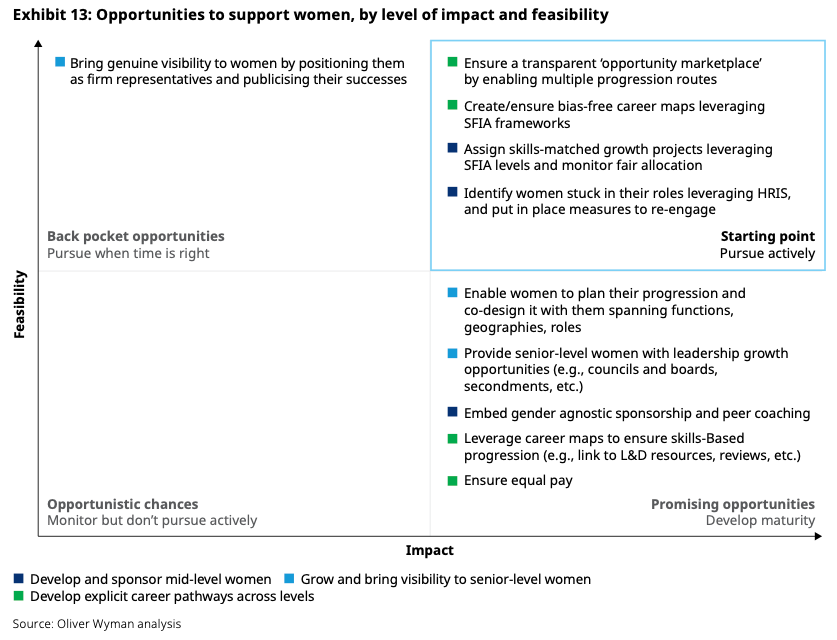
If things are to change, business — ie senior management — needs to step up to the plate. The 2025 Lovelace Reportmakes some very clear, concrete ideas on how companies can stem the flow, based “on what women say they need most”:

  • Develop and genuinely sponsor mid-level women
    • Spot women before they walk
    • Make sure high-impact work is given fairly
    • Back women with sponsors who open doors
    • Run sponsor-sponsee survey to understand how “matching” is working in practice
  • Grow and promote authentic visibility for senior-level women
    • Give senior-level women real leadership opportunities
    • Put visibility and value on the agenda
    • Help them plan what’s next
  • Make career pathways crystal clear at every level
    • Build career maps that actually work
    • Make pay match the path
    • Use maps to drive real development
    • Open up internal opportunities

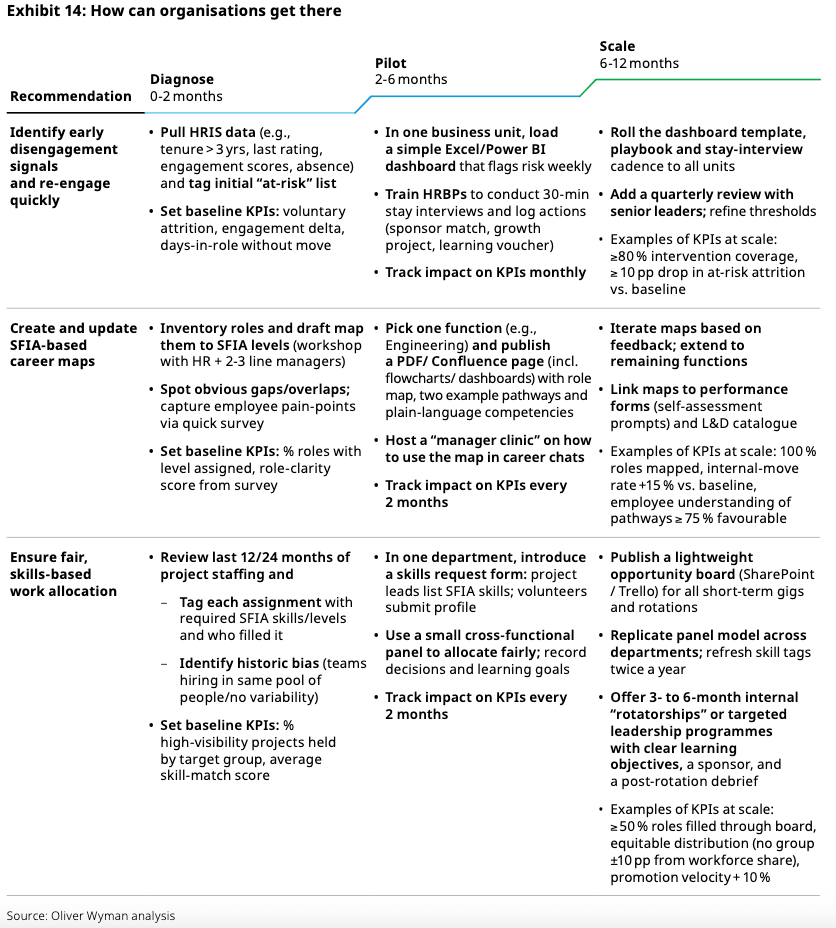
Unlike a lot of reports that make high-level recommendations and then move on, the 2025 Lovelace Report goes into significant detail about what these recommendations mean and how they can be executed. The authors recognise that companies can’t do everything at once and highlight three priorities:

  1. Identify women who’ve been stuck in the same role for years and “re-engage them through skills-matched projects, coaching, development programmes, and sponsorship”
  2. Ensure that “high-impact work is assigned fairly by matching opportunities to skills and tracking who gets access”
  3. Create clear career maps and pathways so that everyone knows how to progress

These interventions are, the authors say, “highly feasible and proven to make a difference”.

Is your company acting?

Is your employer acting on these (or similar) recommendations? And if they aren’t, do you have a sense of why not?

Women’s networks, ERGs and mentoring programs seem fairly common, but what about the other recommendations? Does your company have a career map or provide clear pathways to progress? Are opportunities to work on keystone projects fairly distributed, with ways to check that this is so?

Please leave a comment with your experience!

Sponsors

This work is sponsored by Digital Science. If you’d also like to become a sponsor, to get early access to the report and a briefing on how its findings affect your company, email me for details.

Gender stereotypes result in women being judged as less creative

This work is sponsored by Digital Science. If you’d also like to become a sponsor, to get early access to the report and a briefing on how its findings affect your company, email me for details.

And men being judged as more deserving of reward.

This third chapter in my list of reasons why women in the workplace are struggling to create equity explores a 2015 paper from Devon Proudfoot, Aaron C. Kay, and Christy Z. Koval in which they ran five experiments to test whether men are perceived as more creative than women, including one which tested whether men’s additional perceived creativity would result in greater “deservingness” of a reward.

Their hypothesis was that:

the propensity to think creatively tends to be associated with independence and self-direction—qualities generally ascribed to men—so that men are often perceived to be more creative than women.

That hypothesis was based on the gendered way we think of male and female “traits along the dimension of agency-communality.”

Agency, which is seen as masculine, refers to self-directed behavior and is associated with traits such as adventurousness and self-reliance; communality, which is seen as feminine, refers to concern for others and is associated with traits such as social sensitivity and cooperativeness.

The male-coded behaviours correlate with the general public’s understanding of “outside the box creativity”, leading to men being seen as more creative than women when engaging in the same activities, even when controlled for perceived competence.

The five studies found that:

  1. Men were perceived as better at “outside the box” creativity, which is “more strongly associated with stereotypically masculine characteristics (e.g., daring and self-reliance) than with stereotypically feminine characteristics (e.g., cooperativeness and supportiveness.”
  2. Men were “ascribed more creativity than a woman when they produce identical output” within the context of a male-coded profession (architecture), but not within a female-coded profession (fashion design). Female architects were judged to be less creative than female fashion designers; there was no difference for men. So not only are women judged as less creative than men within male-coded environments, women in male-coded environments are judged as less creative than women in female-coded environments.
  3. “Men’s ideas are evaluated as more ingenious than women’s ideas”. Talks by men about tech, entertainment, business, science and global issues were all evaluated as more creative. There was no statistically significant difference for talks about design, again pointing to the idea (which was not tested) that the gender-coding of the environment matters.
  4. “Female executives are stereotyped as less innovative than their male counterparts when evaluated by their supervisors”, but execs’ direct reports did not rate men and women differently. Poor ratings from supervisors are “explained by perceived, rather than actual, differences in the targets’ creative thinking”.
  5. Men are perceived as more creative when their behaviour is “construed as risky (i.e., when he acted in a stereotypically masculine way)”, but women engaging in the same behaviour are not seen as more creative. Behaving in a riskier way also increased men’s “reward deservingness” compared to women.

In actual fact, “men, in general, do not outperform women in creativity”, yet are persistently seen as more creative and as more deserving of rewards for their behaviours.

These results have obvious implications for women in the workplace, as the authors say:

In suggesting that women are less likely than men to have their creative thinking recognized, our research not only points to a unique reason why women may be passed over for corporate leadership positions, but also suggests why women remain largely absent from elite circles within creative industries, such as film and advertising, and creative professions, such as architecture. Our research may also help explain the dearth of women reaching the upper echelons of science, technology, engineering, and mathematics fields—and in particular, the technology sector, which is projected to become an increasingly large part of the U.S. labor market.

But this also puts women into a double-bind.

In my experience, the majority of people trying to fix gender inequality in the workplace are women. We’ve seen that simple interventions such as women’s networks and employee resource groups have not really helped, so we are going to need to bring much more creativity to the table.

However, if we, as women, are being judged as less creative and less deserving of reward then it’s no distance at all to us and our gender equality projects being judged less deserving of support, our ideas less deserving of attention, and our requests less deserving of action. Which means that the problem of women being given less credit and fewer resources is being tackled by the very people who are given less credit and fewer resources.

And, indeed we see this play out in other related areas: Research by Rosa has found that just 1.8 percent of UK grant funding went to organisations in the “women and girls sector”, and female founders get just 2.8 percent of VC funding.

So not only are women in the workplace being disadvantaged by this bias, but the women trying to fix the disadvantage faced by women in the workplace are being disadvantaged. We are hit by a double whammy.

Which is why I believe that the report I’m currently working on is so important, and why I need your help to find more sponsors. We need to develop an understanding of the practical barriers faced by people (yes, mostly women) trying to enact gender equality policies in business and academia before we can come up with some solutions. But to do that, I need to find another two or three sponsors. If your company would be interested, please email me!

Reference

Proudfoot, D., Kay, A. C., & Koval, C. Z. (2015). A gender bias in the attribution of creativity: Archival and experimental evidence for the perceived association between masculinity and creative thinking. Psychological science, 26(11), 1751-1761.

The glass ceiling is made of small biases frequently applied

This work is sponsored by Digital Science. If you’d also like to become a sponsor, to get early access to the report and a briefing on how its findings affect your company, email me for details.

Woman stuck beneath a glass ceiling.

This week’s paper is a really nice follow-on from last week’s look at how the composition of scientific evaluation committees affects how well (or not) women are treated and how men become more biased against female candidates when even a single woman is present as a peer.

It was pointed out in the comments on Substack that the effect size is small. Which it is. And this week’s paper shows that small effects can still have big impacts.

Insidious Nonetheless: How Small Effects and Hierarchical Norms Create and Maintain Gender Disparities in Organizations by Yuhao Du, Jessica Nordell, and Kenneth Joseph (2022) is a really fascinating look at the cumulative impact of different types of bias on women’s careers.

The team looked at six discriminatory behaviours and modelled their impact on women’s careers to see whether a glass ceiling effect — the “well-established phenomenon in which women and people of color are consistently blocked from reaching the uppermost levels of the corporate hierarchy” — would emerge.

Their model simulated access to projects and responses to performance in order to create a “perceived promotability” score which would control whether that individual would get promoted or not. The model began with perfect equality and was run repeatedly to see what the cumulative impact of these mechanisms might be.

The inputs are based on six biases, all of which have “significant empirical support”:

  • Women’s errors and failures on projects are penalized more than men’s.
  • Women’s successes on projects are valued less than men’s.
  • Women are penalized for exhibiting nonaltruistic behavior.
  • Women receive fewer opportunities for growth [including] fewer assignments that allow them to develop new skills [and] less access to challenging assignments.
  • Women receive more blame when a mixed-gender team fails.
  • Women receive less credit in mixed-gender teams.

Each of these “six mechanisms vary in their effects”, and so are weighted differently based on the magnitude of their impact and the frequency of their occurrence.

The team found that “most significant impacts come from mechanisms that are small but frequently applied” and that the glass ceiling was an emergent property of these mechanisms.

In other words, sexism isn’t one big, dramatic moment of discrimination, it’s the accumulation of lots and lots of small, biased behaviours.

What I also found interesting was that, when all the biases were applied, the model showed a clustering of women in the lowest levels of the company (see fig 1).

Figure 1. The percentage of men (y axis) at each level of the corporate hierarchy (different colors) at each simulated promotion cycle (x axis). Different subplots show results for simulations without any empirically validated biases (left-most), with all of these (right-most), or with each individually (middle subplots; results for biases 1 through 6 are shown from left to right). Error bars represent confidence intervals from 300 randomly initialized simulation runs.

This reflects what we often see in real gender pay gap data where women are clustered in the lowest pay bands because they just aren’t getting promotions. To me, this provides validation that the model Du et al have created actually does reflect what is happening inside real world companies.

The team also tested “a quota-based intervention” which forced the model to promote more women to meet targets at each level of the company. They found that gender disparities returned if the interventions were displaced by the previous gender-biased norms, “even with quota levels as high as 70 percent”.

Whilst quotas may be effective in the short term, in the long term cultural change is needed to maintain gender equality.

This paper shows that the glass ceiling is created by the cumulative impact of small biased behaviours which limit women’s ability to gain promotion. This does make dismantling the glass ceiling a much harder job, because large, simple interventions won’t cut the mustard. Instead, a variety of interventions that tackle the small, insidious biases need to be tried.

At a very basic level, we need to:

  • Ensure women aren’t punished more for errors and failures than men.
  • Value women’s contributions as much as men’s.
  • Accept women’s nonaltruistic behaviour as much as men’s is.
  • Ensure women get the same opportunities for growth and the same access to challenging assignments and skill development.
  • Not blame women more when a mixed-gender team fails.
  • Credit women fairly when a mixed-gender team succeeds.

The question is, how do we effectively do that?


Reference

Du, Y., Nordell, J., & Joseph, K. (2022). Insidious nonetheless: how small effects and hierarchical norms create and maintain gender disparities in organizations. Socius, 8, 23780231221117888.

When the presence of a single woman is enough to trigger sexism

As you might have seen in the main Ada Lovelace Day newsletter, I am currently working on a report about the barriers people face when trying to enact gender equality policies in business. I’m doing a lot of background research at the moment, so I thought that I would share some of the papers and reports I’m reading. 

This work is sponsored by Digital Science. If you’d also like to become a sponsor, to get early access to the report and a briefing on how its findings affect your company, email me for details.

Women sitting alone next to empty chairs.

This week’s paper: Does the Gender Composition of Scientific Committees Matter?

In a stark refutation of Betteridge’s Law of Headlines, the answer to this question is a very emphatic yes, and not in a good way. 

Manuel Bagues, Mauro Sylos-Labini and Natalia Zinovyeva (2017) analysed data from 100,000 applications for promotion to associate and full professorships in Italy and Spain, and looked at whether the gender split of the evaluation committee had an impact on the probability of success for men and women. 

They found that “male evaluators become less favorable toward female candidates as soon as a female evaluator joins the committee”. 

And although “in mixed gender committees, female evaluators rate female applicants higher than their male colleagues, […] the difference is small and statistically nonsignificant”. Thus having “a larger number of women in evaluation committees does not increase either the quantity or the quality of female candidates who qualify.”

In short, women do their jobs fairly whilst men become more biased against female applicants when a woman joins the team. 

Of the academic promotion committees that Bagues et al studied, only 8 percent had a female majority in Italy, and just 6 percent had a female majority in Spain. The paper includes no data on what happened with female-majority committees, which is a shame. It would have been good to know if female-majority committees were fairer, or if female candidates are always going to get the sharp end of the stick regardless of who is evaluating them. 

Bagues et all suggest three possible mechanisms that might explain what’s going on here: 

  1. Backlash: “The presence of women in the committee might unleash a backlash against female candidates, particularly in fields that have been historically dominated by men.” 
  2. Licensing effect: “In all-male committees, evaluators may feel that they have a moral obligation to worry about sexism and seek to overcome it by expressing more positive  (and perhaps less discriminatory) views about female candidates. When there are women on a committee, men may feel licensed to express more honest opinions about female candidates.”
  3. Male identity priming: “female evaluators might strengthen male identities within committees and hence weaken their support for female candidates.”

The team were unable to test these hypotheses. 

I wonder whether there might be a fourth mechanism, which isn’t explicitly examined in the paper: 

  1. Perception bias: Men may be seeing a woman on their evaluation committee as evidence that there are enough women in senior positions, so therefore there is no need to promote anymore. Perception biases exist in groups where women’s presence is overestimated, and in speech where women’s contributions to a conversation are overestimated. It would be logical if there was a perception bias around the number of women in senior roles that is triggered by having a woman as a peer. 

Although this study is focused on academia, it holds that simply having more women involved in promotion processes in business won’t yield more female senior leaders. This is bad news for organisations who thought that increasing the number of women involved in promotion decisions would be an easy fix. It turns out that creating a fair evaluation process is more complicated than that. 

More to the point, there aren’t enough women in male-dominated industries to take on this additional work anyway. Making women do more recruitment would take up proportionally more of their time, reducing opportunities to do work that would progress their career. This kind of pastoral work is rarely rewarded, neither in academia nor industry, and women already do too much of it. 

Is the solution to keep assessment panels all-male? Would emphasising men’s moral obligation to be fair to applicants improve outcomes for women? Or is there another solution? 

Reference

Bagues, M., Sylos-Labini, M., & Zinovyeva, N. (2017). Does the gender composition of scientific committees matter?. American Economic Review, 107(4), 1207-1238.